Our co-founder’s paper on 2,500+ halide double perovskites is out in Scientific Data
Scientific Data has published a paper co-authored by our co-founder and CEO, Dr. Ravindra Shinde: an open dataset of spin-polarised electronic structure and chemical bonding for more than 2,500 halide double perovskites.
Scientific Data has published “Spin-Polarised Electronic Structure and Chemical Bonding Data for 2,500+ Halide Double Perovskites”, a paper co-authored by our co-founder and CEO, Dr. Ravindra Shinde, with Luc Walterbos, Alex McEwan, Janine George and Linn Leppert. It is a Data Descriptor, the journal’s format for describing a research dataset in enough detail for others to reuse it, and it is open access.
A family of materials with room to tune
Halide double perovskites, with the general formula A₂BB′X₆, have been known for decades and are now being rediscovered for solar cells, photocatalysis and radiation detectors. Because two different metals share the B site, the family can be tuned across a very wide chemical range, and magnetic ions bring electron spin into play as well.
What the dataset contains
- More than 2,500 compounds of the Cs₂BB′X₆ family, with iodine, bromine, chlorine or fluorine as the halide: every one that the τ tolerance factor of Bartel and colleagues predicts to be stable.
- Spin-polarised densities of states for each compound, from hybrid-functional density functional theory. 719 of the compounds have band gaps in the visible range, and 118 show half-metallic character.
- Chemical-bonding analysis with LOBSTER, showing how the orbitals interact across the whole set.
- Stability estimates from four pretrained machine-learned interatomic potentials, with each compound’s predicted energy above the convex hull.
- Maps and an interactive app, built on UMAP, for exploring composition, electronic structure and magnetism side by side.
The authors describe it as the first comprehensive set of spin-polarised electronic-structure data for the halide double perovskites predicted to be stable.
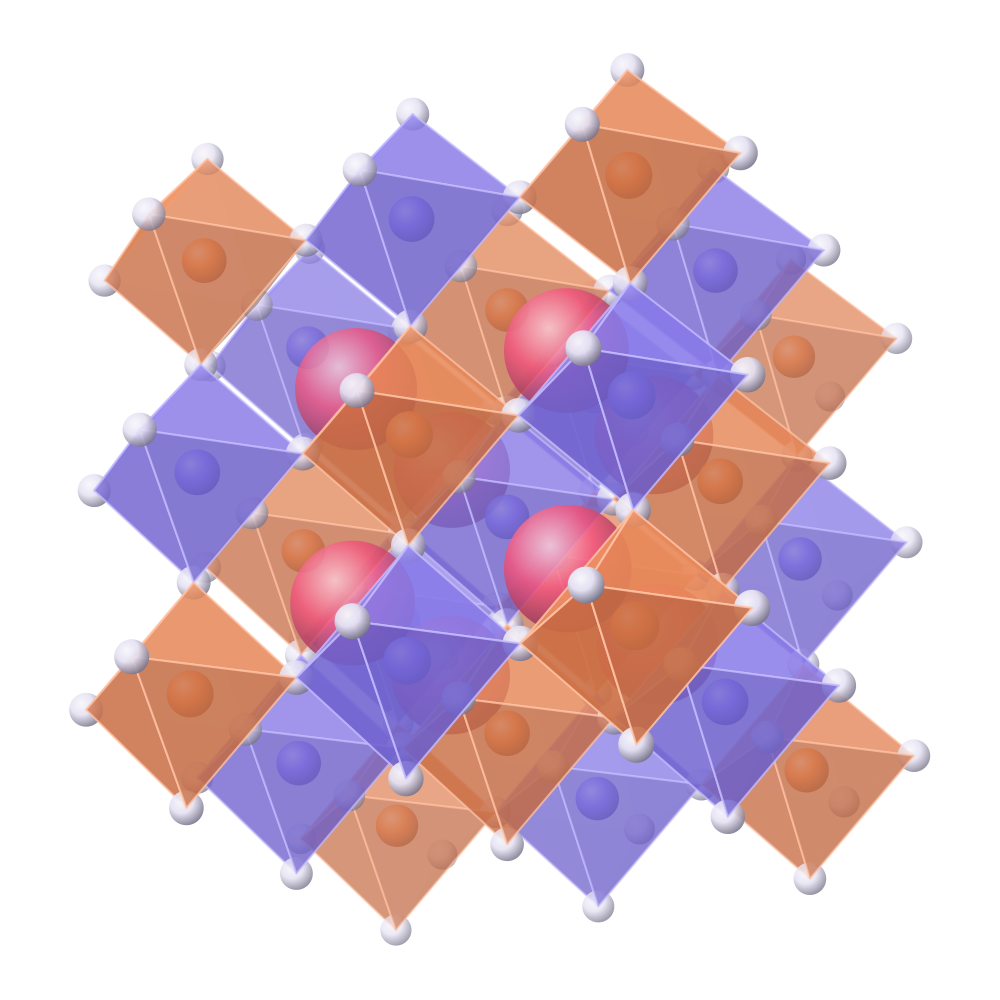
The illustration shows Cs₂AgBiBr₆, the best-known halide double perovskite. Silver and bismuth alternate at the centres of corner-sharing octahedra of bromide ions (orange and violet), with caesium ions (pink) in the spaces between them.
The paper is free to read under a Creative Commons licence. Congratulations to all five authors.