ChemAI in Amsterdam: AI for science is still up for grabs
Our co-founder Dr. Ravindra Shinde spent the builders day of ChemAI 2026 at AI House. Dealroom’s data placed AI for science among the few critical technologies that no region leads yet, and the day’s discussions turned on how Europe can win it.
AI House, Amsterdam · 12 November 2026
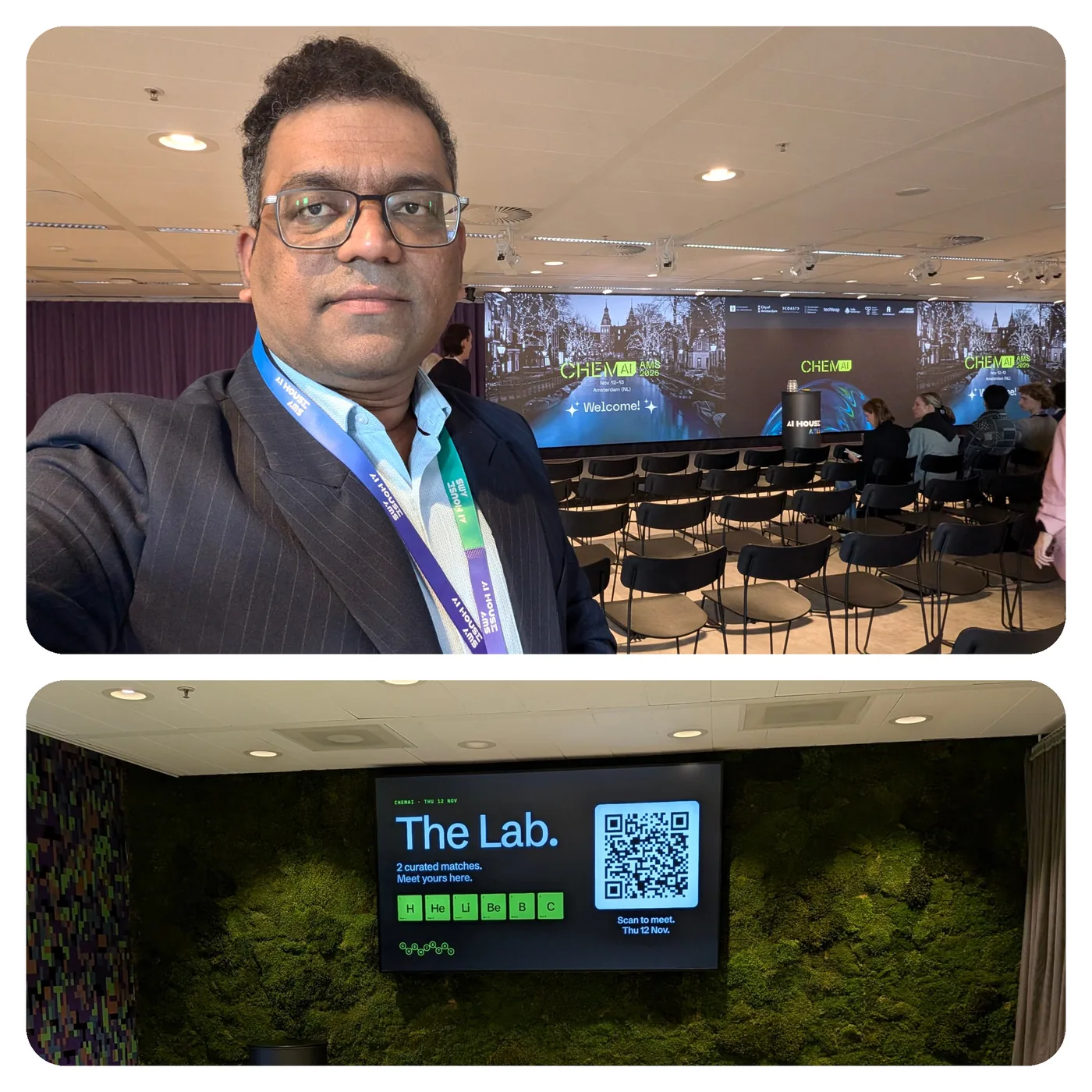
On 12 November, our co-founder Dr. Ravindra Shinde represented Quantanomous at ChemAI x Deep Tech Builders, the first day of ChemAI 2026, at AI House in Amsterdam. The sold-out day brought together more than 200 founders, investors, corporates and ecosystem builders. Its panels kept returning to one question: how do breakthroughs in AI and chemistry become companies that scale?
An open race
Yoram Wijngaarde, founder and CEO of Dealroom, opened with data. By Dealroom’s count, US companies lead 14 of 21 critical technologies, while European companies lead three: server operating systems, mobile chips and EUV lithography. Four fields have no leader yet. AI for science is one of them, alongside quantum computing, humanoid robots and fusion.
His message to the room was direct. European investors should take more risk: invest fast, and accept that some bets will fail fast. Large corporations should work with startups without the red tape. They should keep startups out of long procurement cycles and take the risk of becoming an early customer, because early traction is what a young deep-tech company needs most.
What industry and government are building
Dr. Hanne Falsig of Topsoe showed how industrial catalysts were developed historically and how Topsoe, founded in Denmark in 1940, became a leading name in catalysis. She also showed that its catalyst research continues today. She closed with a point that applies well beyond catalysts: AI for materials needs computer science, modelling, advanced analytics and laboratory automation working together, grounded in deep chemical know-how.
Christian van der Woude, senior advisor for science, technology and innovation at the Consulate General of the Netherlands in San Francisco, described what he sees in the United States:
- AI scientists are entering national laboratories.
- Autonomous labs are growing from demonstrations into networks.
- Industrial R&D is adopting AI co-scientists.
- The Genesis Mission is building one platform for AI-driven science across the 17 national laboratories.
He showed the synergies between the two continents and proposed that the Netherlands partner with the US while building a critical node in Europe. The capital and compute for that include Invest-NL’s €610 million Deep Tech Fund and the AI Factory in Groningen.
Programmes for startups
Marieke Smidt of Oost NL presented the Big Chemistry Startup Program. It is a national grant scheme for startups working across chemistry, AI and robotics, with grants of €125,000 to €200,000 per project. Peter Westerhuijs presented TTT-AI, the national programme that offers AI startups venture building, entrepreneurial support and access to early-stage funding. Ravindra spoke with Peter before the panel and gave Marieke a short presentation of Quantanomous afterwards.
Conversations that continue
In The Lab, the event’s matchmaking room, Ravindra met his curated investor matches. He explained the idea behind Quantanomous to Maaike Vranckaerts and David Drost of Invest-NL. Invest-NL invests at a later stage than ours, and we agreed to stay in touch as we grow. He also met VSParticle, the Delft company whose nanoparticle printers make new materials for research. They discussed how its instruments could support the experimental validation of our candidates.
Why it matters to us
Quantanomous designs new materials to a customer’s specification. High-accuracy physics corrects our AI predictions, and each prediction carries a calibrated probability of success. We then validate the strongest candidates experimentally. ChemAI showed both sides of the opportunity: the field is still open, and industry is asking for exactly this mix of disciplines.
Thank you to the Amsterdam Chemistry Network, AI House, Techleap, Hello Tomorrow, TTT-AI and every partner who made the day possible. If you make, use or invest in advanced materials, write to us.